
.png)


_edited_edited.png)
BT-13A Valiant
The Vultee "Vibrator"
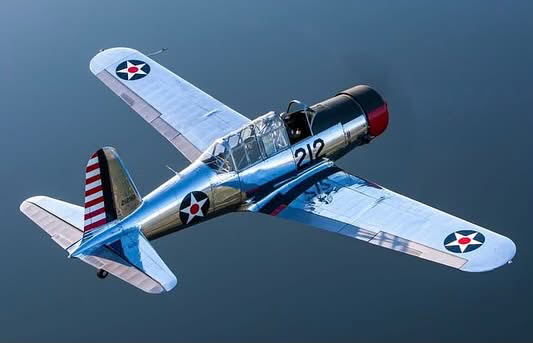
First Impressions: The Vultee Valiant today is perhaps the least known or appreciated of the warbird trainers, but this rugged, single-engine trainer was the backbone of the United States’ military flight training during World War II. True to its name, the Valiant shaped thousands of pilots who defended freedom with skill, courage, and valiant determination. Nearly all U.S. Airmen flew them during their training pipeline.
Background: The whole concept of flight training was (and is) to “stair step” military flight students until they are ready for their final “platform”, whether it be a P-51 Mustang or a B-17 Flying Fortress. Student pilots began in Primary Trainers such as the Boeing PT-17 Stearman Kaydet, the Fairchild PT-19, or the Ryan PT-22 Recruit. Students who satisfactorily completed primary training advanced to Basic Training in the BT-13 (or BT-15 – same airplane with a different engine but same horsepower). After completing Basic Training, students progressed to Advanced Training in either the single-engine pipeline (fighters) or the multi-engine pipeline (bombers and transport). Advanced Training aircraft were the AT-6 Texan for single-engine and either the AT-17 Bobcat, AT-10 Witchita, or AT-7 Navigator for multi-engine. Other multi-engined Advanced Trainers were used in specialty roles such as the Curtiss-Wright AT-9 Jeep (for fighter pilots in the P-38 track) and the AT-11 Kansan (mostly used for bombardier training). The common denominator for Army Air Corps pilots was that all were trained in the Vultee Valiant, which was less about finesse and more about building confidence in a machine that could bite if mishandled.
Gerard "Jerry" Vultee was one of the first aeronautical engineer graduates of the California Institute of Technology (1921). He went to work at Lougheed Aircraft Manufacturing Company (later changed to Lockheed) and worked his way up to chief engineer. He was instrumental in the designs of the Lockheed Vega, the Model 9 Orion (single-engine airliner), and the Model 8 Sirius, specifically built at the behest of Charles Lindburg for scouting new air routes. Vultee left Lockheed in the early 1930s and eventually found himself working with test pilot and engineer Vance Breese at the Aircraft Development Corporation. The company was reorganized in 1934 under the name Vultee Aircraft. Jerry Vultee's first design was the Vultee V-1, a single-engine airliner designed to carry 6 to 8 passengers. American Airlines purchased 14 V-1A models, which were successful as fast and efficient airliners until the Bureau of Air Commerce imposed restrictions on single-engine passenger planes in 1936. Jerry Vultee continued to lead engineering efforts to design rugged, practical aircraft for civilian and military applications. In January 1938 Jerry Vultee and his wife were killed in their Stinson Reliant when they crashed during a snowstorm in Sedona, Arizona. After their tragic death, Dick Palmer was hired to replace Vultee as chief engineer. The BT-13 design emerged under Palmer’s leadership.
In the late 1930s and early 1940s, the Army Air Corps basic flight training honed pilots' skills using the North American BT-9 and BT-14. By mid-1940, the Vultee BT-13A, which excluded the wheelpants from the early model, arose as the new cornerstone of their training fleet, shaping the next generation of airmen. The BT-13B model utilized a 24-Volt electrical system. At the height of WWII, there were 26 Army Air Corps Basic Training schools around the country, and they all utilized the BT-13 (or BT-15). The U.S. Navy also placed an order for the Valiant, designating them as the SNV-1 (BT-13A equivalent) and the SNV-2 (BT-13B equivalent), using them to train Naval Aviators. The U.S. Coast Guard even used some SNVs for training proficiency and utility purposes. The Vultee plant in Downey, California, produced Valiant aircraft and was notable for its pioneering policy of providing equal pay to women artisans and workers, aligning their wages with those of their male colleagues.

Sol Bradman, who owns Island Warbirds, is a lifelong pilot and chose to include a warbird in his Florida Keys flight school. After much research and consultation, he settled on a beautiful, award-winning 1942 BT-13A (s/n 8042), which he affectionately calls Betsy, in honor of Betsy Ross. His Valiant spent the war years training Army Air Corps pilots at Merced Army Airfield, CA (later renamed Castle AFB).
Design: The BT-13, a low-wing monoplane with fixed landing gear, has a robust yet unpolished feel, reflecting its practical, utilitarian design. Like all WWII aircraft, this trainer is indeed a mechanical beast. As a step up from the Primary Trainers, it introduced students to more power and complexity (e.g. flaps are hand cranked at 5 turns per 10˚). Students also were introduced to radio communications, long range navigation (including night), and formation flight. In short, it’s an excellent basic trainer! I’m a big fan of WWII training manuals, complete with drawings, warnings, and plenty of cartoons. The BT-13 training manual is extremely thorough and includes wise counsel such as “Keep the canopy closed when handling your maps!” It also suggests the best diet for eye adaptation to night flying which includes “food rich in Vitamin A – eggs, butter, cheese, liver, apricots, peaches, carrots, squash, peas, and especially cod liver oil and all types of greens”. Yum!
By the end of production, a total of 13,230 Valiants were manufactured including 11,537 BT-13s, 1,693 BT-15s, and 2,000 SNVs. Only the AT-6 Texan surpassed the BT-13 in total production numbers for a WWII trainer.

Ground Operations: The R-985 likes copious amounts of fuel, and six solid shots of prime are a good place to start. Serial number 8042 has an electric engagement for the inertial starter in addition to the original hand crank. The handle (stored in the baggage compartment) can be inserted by a ground crewman into the inertial wheel from the back left portion of the cowling and cranked until it is wound-up at full speed. The hand crank is then removed, and the pilot engages the mesh gear, which then begins to turn the prop. Fuel pressure can be maintained by operating the hand wobble pump by the pilot’s left leg. With some air, spark, lots of fuel and a little luck, the cylinders will begin to cough to life.
The sliding birdcage canopies can be flown while locked at any position, from fully open to fully closed. Taxiing involves some weaving, but visibility is decent, particularly with the forward canopy open, allowing you to lean out. The R-985 adds yet another layer of complexity for students who never flew a supercharged aircraft. The addition of takeoff power requires care to not overboost the cylinders. It’s easy to imagine their adrenaline-fueled laser focus the first time they feel 450 supercharged horses and raise the tail of the Valiant. Visibility is good in that there is no upper wing (as with a Stearman). However, due to the birdcage canopy and large radio antenna mast on the front right side, maintaining a good visual lookout for traffic means constantly shifting your head around.
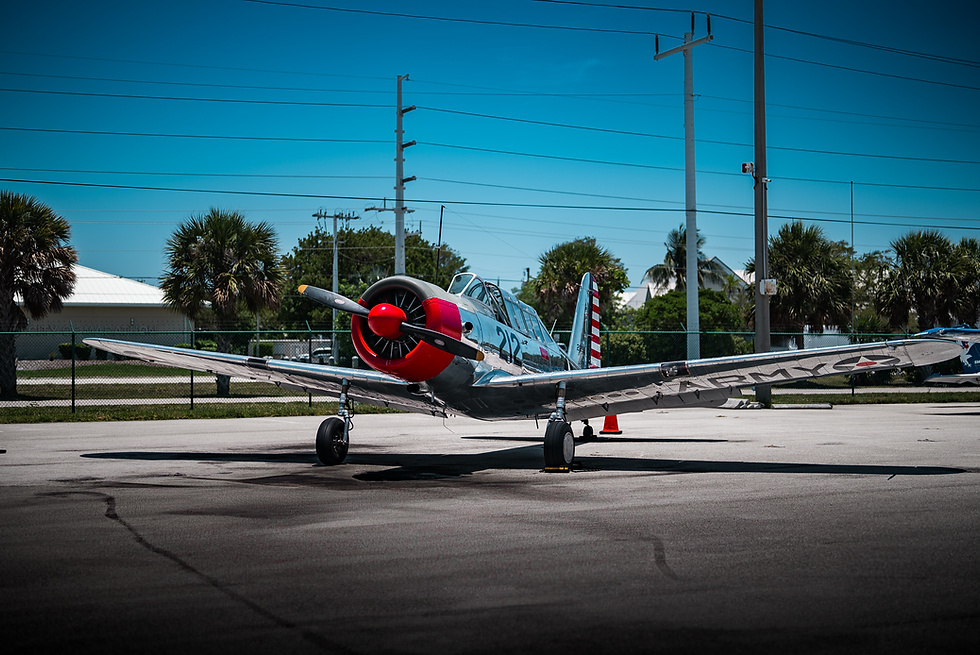
Flight Characteristics: Sol describes flying his Valiant as being like “flying a grandfather clock”, with cables, pulleys and weights. During World War II, airmen affectionately dubbed the Vultee BT-13 the "Vultee Vibrator" for its distinctive rattling sensations. Although I didn’t notice any substantial vibration, its lively nickname likely stemmed from a trio of quirks: (1) the airframe's shuddering buffet as it neared a stall, (2) the birdcage canopy clattering along its track, and (3) the resonant hum of the two-position Hamilton Standard variable-pitch propeller. I didn’t do any particularly aggressive maneuvering and (non-accelerated) stalls produced a normal amount of airframe buffet. Clean stalls occur at 72 mph and dirty stalls (flaps 40˚) at 62 mph. Cruise speed is a blistering 130 mph while burning approximately 25 gph. Each wing tank holds 60 gallons, with the right tank featuring a 17-gallon "reserve" that bypasses a standpipe to access the remaining fuel. Landings are forgiving with the sturdy, wide-stance gear, and crosswinds are easily handled provided proper technique is used.
Wrap-Up: As one of the few remaining airworthy Valiants takes to the sky today, it carries the echoes of a generation that learned to fly under pressure. The BT-13 leaves an indelible mark: a plane that vibrates not only throughout its airframe, but also through the stories of the valiant pilots who flew it. Viva the Vultee “Vibrator”!


I like this one. Classic.