
.png)


_edited_edited.png)
B-17 Flying Fortress
Flying the Fortress

First Impressions: The B-17 is more than just an airplane. It is a monument to a time in history where freedom itself hung in the balance. So much so, that an entire generation of young men left their homes to fight both in and over foreign lands. Flying Fortresses flew in every theater from start to finish, but will always be remembered for the job they did in the hostile skies over Europe as the workhorse of the “Mighty Eighth” Air Force.
There are few airplanes as emblematic as the Flying Fortress. Its majestic form, prickling with 13 guns, symbolizes the American industry, ruggedness and sacrifice that played such a large part in stopping tyranny and preserving world freedom. While the Fortress is an impressive and glorious aircraft to behold, more importantly, it reminds us of its 10-man crews who fought (and often died) more than four miles above the earth. They battled Messerschmitts and Focke-Wulfs, Anti-Aircraft Artillery (flak), aircraft malfunctions, and frigid temperatures, flying in formations of hundreds while navigating through bad weather to their targets, deep in enemy territory. Today, the B-17 serves as both a symbol and memorial of effort, bravery and the price of freedom.
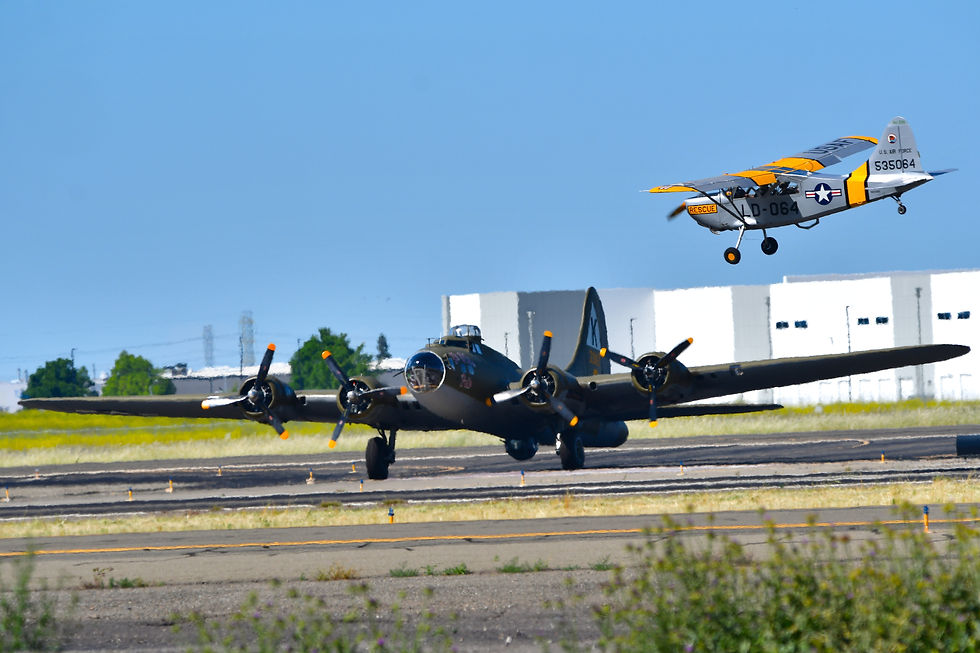
To be able to fly such a machine today is a very rare privilege. But to be able to drop bombs, operate the ball turret and shoot the guns 80 years after WWII is not something that most would fathom as possible. However, “Bomber Camp”, an annual event held in Stockton, California, makes this surreal experience possible.

Bomber Camp: A lifelong dream, Taigh Ramey created “Bomber Camp” in 2008, after years spent in research and collecting bomber equipment, guns and artifacts. Needless to say, Bomber Camp could not be a reality without a bomber. In recent years, the Erickson Aircraft Collection’s B-17, “Ye Olde Pub”, has been flown down to Stockton from Madras, Oregon several days ahead of Bomber Camp so it can be configured back to true bomber status in preparation for the arrival of guest bomber “crews”. A team of experts and enthusiasts install working guns, bomb wiring harnesses, solenoids, electro-mechanical actuators, bomb shackles, and the once Top Secret Norden bomb sight. All the support equipment and vehicles that are used in this endeavor are genuine WWII vehicles including a 1942 Ford staff car, a Cletrac M-2 tractor tug, and Cushman trike. The instructors include reenactors who are dressed in period-correct US Army Air Corps uniforms. Most of them sleep on WWII Army cots in a hangar. When the air crew “students” arrive, they are immediately required to change into WWII green coveralls and khaki covers (hats). They attend classes in a hangar surrounded by WWII aircraft equipment, training devices, and publications. There is even an admin office with a clerk tapping away on an old-fashioned typewriter. Classes include bombing theory, navigation, armament, air-to-air defensive gunnery, and operation of the Norden bomb sight. At lunch time, chow is ladled onto your mess tin by the mess sergeant, who tells you to “eat it with a smile” (it’s actually pretty good).

After lunch, students get hands-on practice using the bomb site, loading and employing guns, and operating a ball turret mounted on a stand. It is truly an immersive experience. When training is complete, the students are assigned to their flight crews and given safety briefs before loading aboard “Ye Olde Pub”. Warbird pilots Mike Oliver and Doug Griffin start the engines after first pre-oiling and priming each engine, setting the mixtures to idle/cutoff and the magnetos off. One engine at a time, the electric starters are engaged until they are at maximum rpm. Then the mesh switch is used to engage the starter gears, spinning the prop. After nine blades are counted, the magneto is turned to “hot”. As the cylinders begin to fire, the co-pilot “tickles” the electric primer switch to keep the engine alive with fuel. With the first engine firing regularly, the mixture is placed to auto-rich. Only three more to go!
Everyone at Bomber Camp had the great opportunity to meet a 100-year-old WWII B-17 pilot. Former 1st Lt. Martin Agegian, US Army Air Corps, served in the 18th Squadron, 34th Heavy Bombardment Group, Eighth Air Force in Mendelsham, England from 1944 to 1945. A few of us had the chance to hear him tell story after story about his harrowing missions deep over enemy territory in the “Flying Dutchman,” as his bomber was named.
While waiting in the waist gun section of a B-17 for the weather to clear, with the soft patter of rain on the fuselage, he told us that, despite the dangers and “close calls”, not a single “Dutchman” crew member recieved even a scratch during 15 combat missions. The same could not be said of his sheepskin lined pants, which were ripped open when a piece of shrapnel came straight through the bomber’s floorboard. On another occasion flak passed within inches of both his and his copilot’s nose. The shrapnel was so hot, it scorched and melted the plexiglass side windows when it passed through. He also told of the tragic time when another B-17 received a direct hit and exploded right above his bomber. The concussion was so fierce, it wrenched the yoke out of his hands and caused his bomber to violently roll. Fortunately, he was able to right his machine and complete their mission.

First Lt. Agegian specifically recounted May 8th, 1945 - VE Day (Victory in Europe). While obviously a great day of revelry throughout England and Europe, his commanding officer required everyone to remain on base and attend church services and memorials held for their fallen brothers. He agreed it was the right thing to do, and nobody resented the order. It was certainly a special honor and a sobering experience to meet one of the few remaining Eighth Air Force airmen from the Greatest Generation of those who unhesitatingly put everything on the line for the cause of freedom. Footnote: since this privileged meeting with Mr. Agegian, he has passed away. RIP and thank you!
Background: The Boeing Model 299 first flew in 1935 and was powered by four Pratt & Whitney S1E-G supercharged, nine-cylinder engines rated at 750 horsepower each. It was designed to compete for the U.S. Army Air Corps’ need for a new long-range bomber. The Model 299 exceeded their requirements. It could carry a 2,500 lbs. bomb load over 2,000 miles at more than 200 mph. At that time, it was the largest landplane ever built. With only five .30-caliber Browning machine guns, this prototype wasn’t nearly as “prickly” as the eventual war time production Flying Fortresses, but it had enough guns that Seattle Times newspaper reporter (Richard Williams) described it as looking like a “flying fortress”. Boeing quickly adopted the fitting name for what has become a legend.
The nose turret was mounted on top of the glass nose and the waist guns were mounted in swiveling and pivoting side “blisters”, similar to a PBY Catalina (which also had its first flight in 1935). Sadly, only three months after the first flight of the Boeing Model 299, it crashed after takeoff due to the crew forgetting to disengage the control lock. Interestingly, it was a result of this preventable oversight, was the inception of the now standard “check list” for all aircraft types.

While the tragic crash of the Model 299 caused Boeing to lose the competition (to the Douglas B-18 Bolo), the Air Corp leadership saw the strategic usefulness in the design and procured funds to purchase 12 aircraft. They were designated YB-17s (the original 299 was retroactively redesignated XB-17, even after it had been destroyed). Eventually becoming operational, the “Y” was dropped and the B-17 went through numerous (and extensive) modifications with accompanying series designations (B-17A/B/C/D/E/F/G/H). By the end of the war, a whopping 12,731 had been built by Boeing (and, under contract, by Douglas and Lockheed Vega).
Powerplants: Four turbo-supercharged Wright R-1820-97 Cyclone nine-cylinder engines, which produce 1,200 horsepower each, are translated to thrust via three-bladed Hamilton Standard constant speed, full-feathering propellers. The R-1820 was one of the most widely used engines of the era. To meet production requirements, it was built under license by Pratt & Whitney Canada, Lycoming, Studebaker, Hispano-Suiza, and in the Soviet Union as the M-25. The turbo-supercharged engines compress ambient air twice before entering the cylinders and allow the B-17 to fly at high altitudes, where it could better mitigate the threats of flak and enemy fighters. Of course, the high operating altitudes meant temperatures down to -50˚, and the B-17 was neither pressurized nor heated. Flight crew members wore heated suits, and oxygen masks were necessary at high altitudes. When these systems failed, they had to deal with hypoxia and frostbite.

Six fuel tanks provide 1,700 gallons of fuel. “Toyko tanks” in the outboard portions of the wings have nine baffled cells each, providing an additional 540 gallons and enabled bombing missions to eastern Germany. For ferry flights, two 410-gallon tanks could be installed in the bomb bay, giving the bomber a 3,400 miles range. Each engine has an oil tank with a 37-gallon capacity. For normal (non-combat) cruise, the B-17 burns approximately 200 gallons per hour and 10 gallons of oil per hour.
Offensive Armament: Obviously, the purpose of a bomber is to drop bombs on the enemy, thereby degrading their ability to wage war. The bomb bay has four bomb rails (two inboard and two outboard) that can carry up to 8,000 pounds of bombs internally. The inboard bomb rails form a “V”. A narrow catwalk passes between the V, allowing crew members to pass between the cockpit and the radio room as they hold onto a woven rope to keep from slipping into the bomb bay and possibly out of the aircraft (if the doors are open).
A bomber is only as effective as its bombardier; an expert in bombs, fuses, and weaponeering. A bombardier must have intimate knowledge of the plane’s electrical system, bomb bay doors, intervalometer, and the autopilot. Incorrect loading and fuzing could cause bomb-to-bomb collision immediately upon release, leading to the loss of the entire crew in a flash. The “secret weapon” of bombardier’s “tool kit” was the Norden bomb sight; a gyro-stabilized, mechanical, analog computer with downward aimed optics. Once the pilot successfully reached the IP (Initial Point), “the ship” was turned over to the bombardier, who coupled the aircraft to the C1 autopilot. The bombardier was the “tip of the spear”. He sat, hunched over sitting on a tiny stool, his eye to the eyepiece and his fingers busily adjusting an assortment of leveling knobs, caging knobs, drift knobs, and sighting optics until flicking the bomb release switch when the DPI (Desired Point of Impact) was in the crosshairs. From IP until “bombs away” the bombardier was in charge of the Fortress.
Defensive Armament: For a bomber to be effective, it must survive long enough to make it to the target area. Ideally, both the plane and crew also make it home to fight another day. Besides the threats of flak, poor weather, and engine malfunctions, there were the ruthless enemy fighters. Heavy bombers are big, lumbering giants that were vulnerable to such fast and high-flying German fighters as the Messerschmidt Bf-109 and Focke-Wulf 190. The aptly named Flying Fortress sought to even the odds, bristling with up to 13 guns (B-17G), all of which were Browning AN/M2 .50 caliber weapons with a firing rate of 13 rounds per second. Weapons expert Scott Rickard calls the gunners, the “grunts of the sky” and indeed, these men fought around the defensive “walls” of their fortress. One of the best-known WWII gunners was SSgt Maynard “Snuffy” Smith, for his actions while serving as a ball turret gunner on May 1st, 1943. After his turret lost power and communications due to severe hits from both AAA and German fighters, he climbed out of the turret, and for 90 minutes, he alternated between fighting a massive fuselage fire, tending to wounded crewmembers, tossing out belts of exploding ammunition, and manning the waist guns to fight off enemy fighter attacks. When the bomber finally landed, the melted fuselage broke in half and there was more than 3,500 bullet and shrapnel holes in the Fortress. He was awarded the Medal of Honor for saving the lives of his fellow crew members.
The guns from nose to tail as follows; The electrically powered and hydraulically actuated Bendix chin turret (B-17G only) was operated by the bombardier when he wasn’t heads-down in the Norden bomb site. The left cheek gun was operated by the bombardier (primary) but could be operated by either nose compartment crewmen. The navigator could operate the right cheek gun (primary) or left cheek gun (secondary), if the bombardier wasn’t operating it. The flight engineer operated the Sperry top turret (twin .50s) in the aft section of the cockpit, while the radio operator protected the aircraft from the 6 o’clock high position with the top aft-facing gun. The belly gunner operated the Sperry ball turret (twin .50s) under the fuselage, immediately aft of the radio room in a position that feels completely exposed. Next comes the right-side waist gunner, followed by the left side waist gunner. The B-17G models staggered the right and left side waist gun windows to give the waist gunners maneuvering room inside the fuselage. The tail gunner manned twin .50s, watching, protecting and fighting alone, 25 feet away from the closest crew member.

Employing the B-17 was a life-or-death team effort. The crews trained and stayed together to the maximum extent possible during their tours. The bomber teams extended beyond the aircrews; the maintenance crews worked tirelessly all night long to repair, service, and load their “Forts” for the next mission. Once the bombers were airborne, they would grab a few hours of sleep and anxiously wait (and pray) for their bomber’s safe return. Once back, the cycle would start all over again as they cleaned out all the spent .50 caliber brass casing and, too often, wiped up the blood of their friends from the aluminum floors. It was a lot to ask of young men, most still in their teens, but they did it time and time again.

Flight Characteristics: As one would expect, the B-17 is a heavy flying machine and takes physical effort to fly. Flying for merely a few hours in light to moderate turbulence made me appreciate the pilots that wrestled these machines for more than eight hours while keeping their assigned position in formation.

On descent, manifold pressures are reduced about 2” every two minutes. Arrive in the landing pattern at about 28” of manifold pressure and 1900 rpm. Without landing gear doors, there is no maximum gear extension speed, but pilots usually lower the gear at the same speed at the flap extension (147 mph). With mixtures rich (levers aft, not forward!), boost pumps on, three down and locked indications, and flaps set to 1/3, the pilot at the controls begins the descent from pattern altitude. Turning base, the flaps will be lowered to the 2/3 position. Turn to arrive on a stabilized ½ mile final at about 105 to110 mph and the propellers can be pushed in to fine pitch to be prepared for a go-around. Flare the Fortress while pulling the power levers until in a three-point attitude. In this husky machine is in a constant state of making small corrections, which equates to what seem like large inputs. After slowing to taxi speed, unlock the tailwheel to taxi. Besides the sheer size and mass of the heavy airplane, it is an honest and relatively easy taildragger to land.

Wrap-Up: The Flying Fortress is an important part of the history of the free world. It served for the entirety of WWII as a power-projection platform. Even though the Fortresses’ crews suffered staggering losses, they were (and shall ever be) held in high regard. Of all the heavy WWII bombers, the “Fort” could take the most hits and still limp home. For this, their crews and maintainers loved them. Of course, it was their courage, bravery and fortitude that turned the Fortress into a legend.
The Erickson Aircraft Collection of Madras, Oregon has an important part in preserving the history of “Ye Olde Pub” and many other warbirds. While it is one thing to see these aircraft in museums, it is a whole other experience to hear and see these artifacts “come to life”. The spinning props, the majestic radial rumble, and the combined smells of oil, gasoline, and hydraulic fluid bring history to life through our senses, creating indelible memories. Bomber Camp takes this one level further: It provides a deeper appreciation and comprehension of what it was like for crew members to take to the air, drop bombs, and operate the guns of a real B-17 FLYING FORTRESS!


Comments