
.png)


_edited_edited.png)
DeltaHawk RV-14
Updated: Jul 24
Jet Fuel Burning Diesel Engine Fun

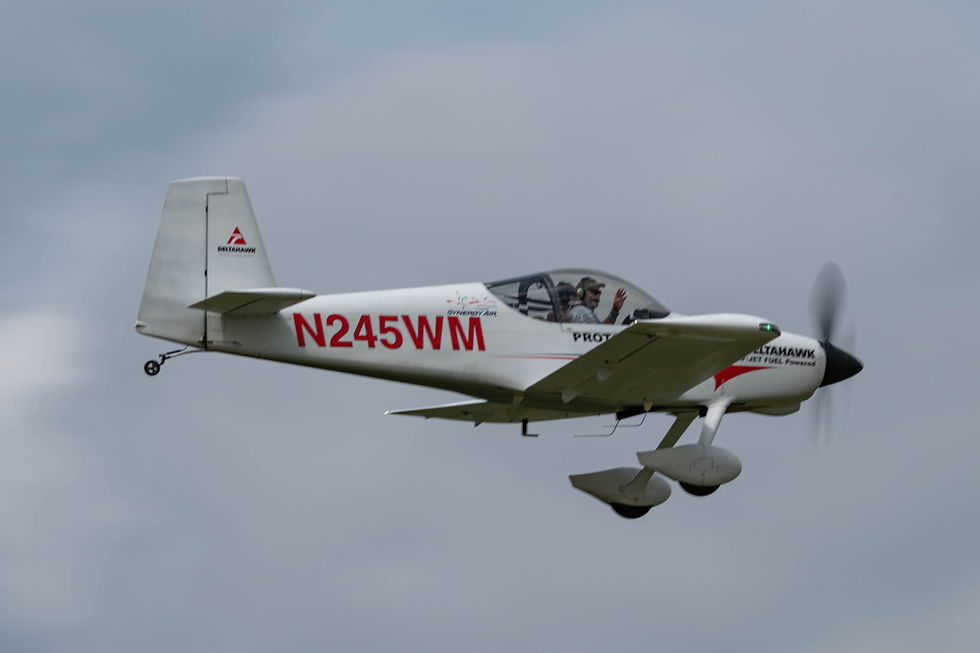
First Impressions: Something in the traffic pattern sounded different. It wasn’t a radial, a Rotax, or a standard horizontally opposed aircraft engine. The RV-14 that I saw was zipping along fine but I couldn’t put my finger on why it sounded unusual until I saw the word “PROTOTYPE” emblazoned on the fuselage and the “DeltaHawk” logo after it landed. As a big fan of Van’s Aircraft, I have looked forward to the opportunity to fly the RV-14, one of the last two that I hadn’t flown. As expected from the Van’s line, this model is a great design. However, the truly unique aspect of the particular RV-14 I flew is that it is powered by a diesel engine, a rarity (at least for now).
Design: Van's Aircraft has long been the gold standard for homebuilt aircraft, and the RV-14 benefits from that legacy of proven designs. Debuting in 2012, the RV-14 evolved as a two-seat variant of the popular RV-10, sharing the same constant-chord airfoil. Like its four-seat sibling, the RV-14 offers generous head and shoulder room. A large baggage area behind the seats will accommodate up to 100 pounds. Van’s homebuilt kits have advanced significantly; the RV-14 kit features pre-punched, matched-hole aluminum parts that self-jig during assembly, greatly reducing the first-time builder intimidation factor.

Craig Saxton resides in the Pacific NW and has been an award-winning airplane builder for over 30 years. In all, he has built or participated in building six airplanes with three more “in the hopper”. The RV-14 is ideal for his business travel between northern California and Washington. Synergy Air of Eugene, Oregon (and a satellite facility in Newnan, Georgia), specializes in assisting builders tackle Van’s Aircraft projects. Craig has used their help with his airplane projects for many years. Their expertise (over 400 aircraft built or assisted) in deciphering plans and teaching skills prevents costly, time-consuming mistakes. Most importantly, their help significantly reduces builders’ frustration.
As a builder/pilot, Craig is always looking for better performance, particularly to fly over the Cascades in his backyard, which often requires a 12,000-foot cruising altitude. He uses Pure Medical’s Inogen oxygen concentrator that supplies O2 in demand (via cannula) up to 18,000 feet with no tank. In addition to better performance, Craig looks for ways to improve economy, calculated in both miles per gallon and dollars per mile. This quest led him to the DeltaHawk booth at Oshkosh in 2023. The folks at DeltaHawk were very much interested in marrying their engine to an RV-14, so Craig facilitated the teamwork between them, Synergy Air, and himself. Synergy Air completed the lion’s share of the RV-14 integration, and the project was finalized in May of 2025. Craig has been flying his jet-fueled prototype all over the country (including OSH 2025) ever since.
Powerplant: DeltaHawk Engines, Inc., based in Racine, Wisconsin, introduced groundbreaking diesel powerplant to general aviation—and it is now FAA type-certified. Craig's RV-14 features the smallest in the DeltaHawk line-up, the DHK180A4: a compact 180-horsepower, liquid-cooled, inverted V4. It is double boosted with a belt-driven supercharger and an exhaust-driven turbocharger. Deltahawk uses an inverted V design to provide great over-the-cowl visibility. Unlike other diesel engines, its direct-drive design does not utilize a gearbox. Its mechanical fuel injection, without the complication of a FADEC system, utilizes four independent fuel pumps for exceptional reliability. The compression ignition system uses 4 glow plugs for ease of starting in cold weather, and an optional Tanis pre-heat system provides easy starting in extremely cold weather. The engine is liquid cooled with Coolanol anti-freeze. If this setup sounds remarkably like a diesel, that's because it is—one optimized for the skies, weighing just 335 pounds, far lighter than your truck's powerplant.

However, unlike the fuel consumption of your diesel pickup truck, the DeltaHawk delivers some pretty eye-watering economy, especially when paired with Craig’s sleek RV-14. He can get 172 KTAS at 12,000 feet while burning only 7.3 gallons per hour! On our short flight together, I saw fuel consumption as low as 1.8 gallons per hour while orbiting at 80 knots at 3,000 feet!
Ground Handling/ Takeoff: Thanks to the Vertical Power Systems VP-X electronic circuit breaker system, there are very few circuit breakers to check. Before start-up, warm the glow plugs for 10 seconds, then turn the fuel boost pump on and hit the start switch. The first big difference you will notice is the sound of the engine. There is no gearbox (like Rotax engines), and the RPM is similar to modern reciprocating engines, but the sound is a bit more guttural. After switching on the idle governor and powering on the full Garmin suite (10” G3X, 7” G3X, GTN 750, GFC 500 autopilot), we were ready to taxi.
Flight Characteristics: I confess an abiding love for all manner of flying machines; each tuned to its own mission. Some days I simply want to climb aboard with friends and wander the sky, destination optional. Sometimes I need to get places and might have to file IFR. I never refuse the opportunity to go upside-down, and nothing beats dropping in on friends at a quiet grass strip. Few aircraft can wear so many varied hats with equal grace, but the RV-14 does so effortlessly—comfortably and economically,
The RV-14 looks fast even on the ground—and it delivers. Flying qualities are excellent: predictable, beautifully balanced, and still nimble, all exactly what one would expect from the latest evolution of Van's line-up. Yet, it remains comfortable even during long cross-country legs (a virtue that grows dearer with every passing birthday). It’s no runway hog either. Combine all these qualities, and you have a true all-around champion.

Even though his current 180-horsepower DeltaHawk engine is nearly 45 horsepower less than his tweaked 223-horsepower Lycoming IO-390 Thunderbolt-powered RV-14, Craig is still seeing similar performance numbers. By himself, he observes over a 1600 fpm climb rate in his 180-horsepower DeltaHawk RV-14 versus over 2,000 fpm in his 223-horsepower IO-390 RV-14. Unlike the IO-390 RV-14, his DeltaHawk plane doesn’t lose power as it climbs “uphill”, thanks to the double-boosted air going to the cylinders. DeltaHawk engines excel economically, delivering 35 to 40% better fuel efficiency than comparable AvGas engines—savings you’ll see right away at the pump. When flying on a max range profile (167 KTAS), the DeltaHawk burns 7.0 gallons per hour. With no wind, this aircraft flies for about 27.4 statute miles (23.9 NM) per gallon. To top it off (pun intended), Jet-A averages about $1 cheaper than 100LL at most airports Craig frequents. The DeltaHawk could run on road (or farm) diesel (with anti-ice additive) but, for FAA certification, the engine is tuned for Jet A. Besides the price advantage (in most places), jet fuel is easier to procure globally. While we pilots have no issue finding 100LL in our usual stateside travels, remote regions around the world prove more challenging to purchase AvGas.
The team—Craig Saxton, Synergy Air, and DeltaHawk—is advancing several exciting projects. First, they are integrating the latest 200-hp DHK200A4 engine into another RV-14, featuring a fully redesigned cowling. They expect the extra power to match or surpass IO-390 performance at low altitudes and significantly outperform it at higher altitudes, while also achieving substantial fuel-efficiency gains. Furthermore, integration efforts have begun for DeltaHawk engines on both the RV-10 and RV-15!
Wrap-Up: Craig Saxton’s DeltaHawk powered RV-14 is more than a proof-of-concept—it is a glimpse of general aviation’s diesel future. With FAA type-certification in hand, DeltaHawk engines are making their way into general aviation, all while sipping widely available Jet-A. The airframe’s versatility is now wrapped in a far thriftier package. As Craig, Synergy Air, and DeltaHawk prepare the 200-hp DHK200A4 for its own RV-14 integration, one thing is clear: the age of the practical, efficient, jet-fueled homebuilt has arrived.


Comments